
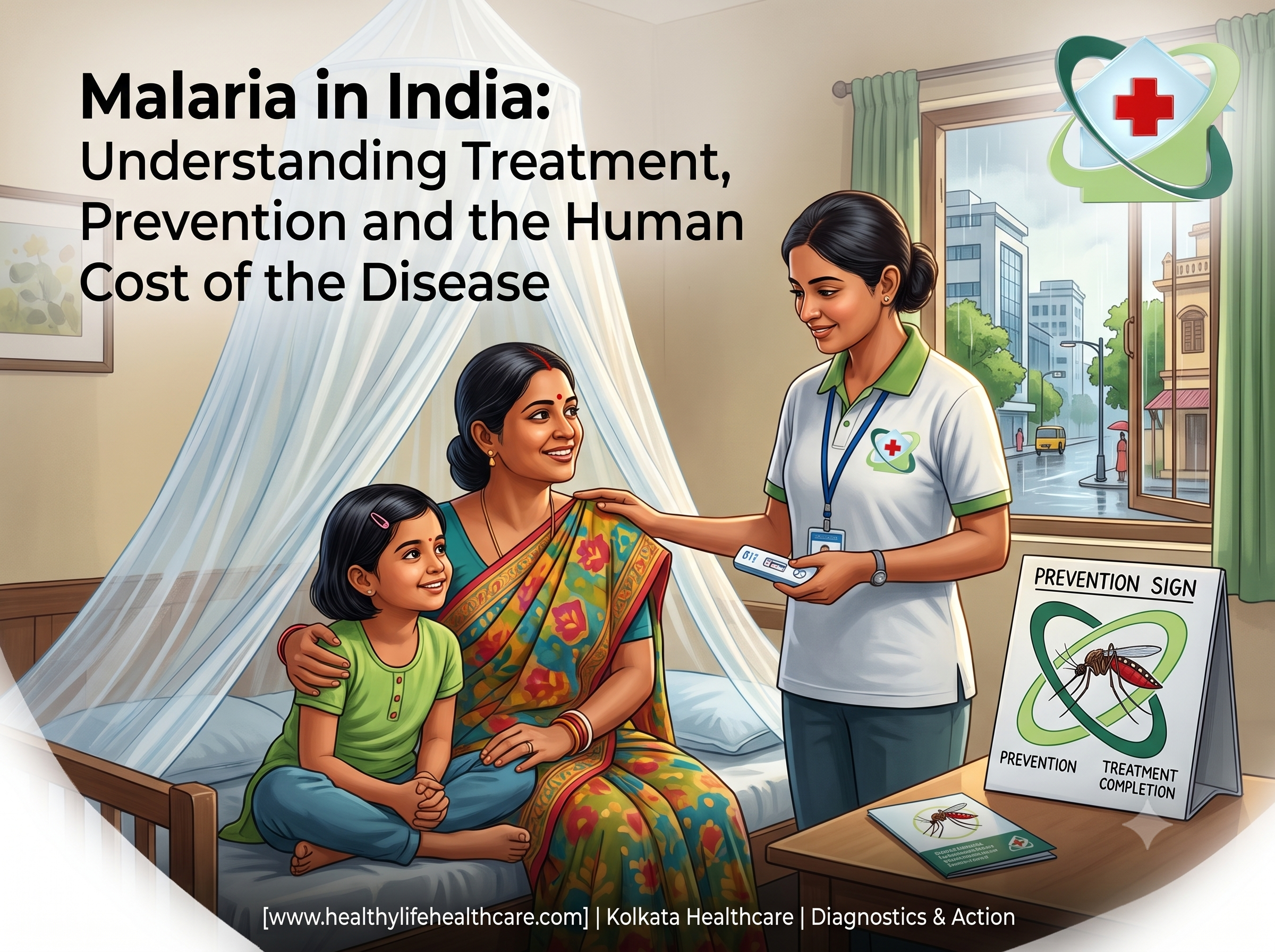
Malaria is more than a mosquito-borne illness. For families across India, it can mean missed school days, lost working hours, financial pressure and, in severe cases, a medical emergency. The good news is that malaria is both preventable and treatable when it is identified early and managed appropriately.
For people living in Kolkata and surrounding areas, awareness of malaria symptoms, malaria testing, malaria treatment and mosquito prevention can play an important role in protecting families and communities.
Understanding Malaria
Malaria is an infectious disease caused by Plasmodium parasites and transmitted primarily through the bites of infected female Anopheles mosquitoes. It is not spread through ordinary person-to-person contact. The two parasite species that pose major health concerns globally are Plasmodium falciparum and Plasmodium vivax.
The first symptoms can sometimes look like an ordinary fever. This is why people may initially ignore them or assume that they are caused by another common infection.
Typical malaria symptoms include:
- Fever
- Chills or shivering
- Headache
- Weakness and tiredness
- Muscle or body aches
- Nausea or vomiting
Because these symptoms can overlap with other illnesses, testing is important rather than relying only on symptoms.
Why Early Malaria Testing Matters
A fever does not automatically mean malaria. Several infections can cause similar symptoms, and identifying the actual cause helps healthcare professionals decide on appropriate treatment.
WHO recommends parasite-based testing for people suspected of having malaria, using methods such as microscopy or a quality-assured rapid diagnostic test (RDT).
For families searching online for a malaria test in Kolkata, a reliable diagnostic laboratory can help with timely testing. A blood test may be particularly important when fever is accompanied by chills, headache, weakness or a history of mosquito exposure.
At Healthy Life Healthcare, accessible diagnostic services can help people take the next step when an unexplained fever raises concern. The goal is not simply to perform a test—it is to help people obtain useful medical information early.
Malaria Treatment: Why Professional Medical Advice Matters
Malaria is treatable, but treatment depends on several factors, including the parasite species, severity of illness, age, weight, pregnancy status and local patterns of drug sensitivity.
WHO states that artemisinin-based combination therapies (ACTs) are the mainstay of treatment for P. falciparum malaria, while treatment for P. vivax can involve different medicines depending on the circumstances and local recommendations.
This is why people should not self-medicate for malaria or assume that an old prescription will be appropriate for a new illness.
A doctor may first recommend diagnostic testing and then select the appropriate treatment based on the result and the patient's individual condition.
Completing the prescribed treatment is also important. Stopping medicines early or taking inappropriate medicines can contribute to treatment failure and broader antimicrobial resistance concerns. WHO emphasizes that effective malaria treatment should rapidly eliminate the parasites and prevent progression to severe disease.
When Malaria Can Become an Emergency
Although malaria can begin with relatively mild symptoms, some infections can become severe.
WHO identifies warning signs of severe malaria that can include impaired consciousness, seizures, difficulty breathing, jaundice, abnormal bleeding and extreme weakness. P. falciparum malaria can progress rapidly if untreated.
Anyone experiencing severe symptoms should receive urgent medical attention.
Children, pregnant women and certain other vulnerable groups can face a greater risk of severe disease.
Malaria Prevention Starts at Home
Preventing malaria is not only the responsibility of healthcare professionals. Families and communities can reduce mosquito exposure through simple, consistent precautions.
1. Prevent mosquito bites
Use appropriate mosquito protection, particularly during times when mosquitoes are active. Mosquito nets, screens, repellents and suitable clothing can help reduce exposure.
2. Remove stagnant water
Mosquitoes can breed in standing water. Regularly inspect flowerpots, buckets, coolers, containers, drains and other places around the home where water can collect.
3. Keep surroundings clean
Community cleanliness is an important part of mosquito-control efforts. Removing potential breeding sites around homes can contribute to reducing mosquito populations.
4. Do not ignore persistent fever
One of the simplest forms of prevention is awareness. If someone develops fever with chills, headache or other concerning symptoms, medical advice and appropriate testing should not be unnecessarily delayed.
WHO identifies mosquito-bite prevention and vector-control measures, including insecticide-treated nets and indoor residual spraying in appropriate settings, as important malaria-control measures.
Malaria Prevention in Kolkata: A Community Responsibility
Kolkata is a densely populated urban environment where public health depends not only on individual actions but also on community awareness.
A discarded container holding stagnant water may appear insignificant, but mosquito-control efforts work best when households, communities, healthcare providers and local authorities all participate.
This is why malaria awareness in Kolkata should go beyond seasonal concern. Families should know the warning signs, understand the importance of timely testing and maintain mosquito-control habits throughout periods of increased risk.
A Human Approach to Fever and Healthcare
Behind every malaria diagnosis is a person.
It may be a child who cannot attend school, a parent who cannot go to work, an elderly family member who suddenly becomes weak, or a household worried about medical expenses.
Healthcare should therefore be about more than treating a disease. It should also be about making diagnosis accessible, explaining medical information clearly and helping families make informed decisions.
For people searching for malaria testing in Kolkata, blood test laboratories in Kolkata, fever testing or home blood test services in Kolkata, convenient healthcare access can make it easier to seek professional advice when it is needed.
Healthy Life Healthcare: Supporting Timely Healthcare in Kolkata
At Healthy Life Healthcare, Kolkata, the focus is on making healthcare services more accessible to individuals and families.
When fever or other symptoms raise concerns about malaria, timely consultation and appropriate diagnostic testing can help patients understand what may be happening and determine the next appropriate medical step.
Remember: a fever should not automatically be assumed to be malaria, and malaria should not be diagnosed through symptoms alone. Testing and professional medical evaluation are important.
Final Message
Malaria remains a significant public-health concern, but it is a disease that can be prevented and treated.
The most important steps are simple:
Recognize the symptoms.
Get tested when malaria is suspected.
Follow professional medical advice.
Complete prescribed treatment.
Prevent mosquito bites.
Remove mosquito-breeding sites.
Protect your family and community.
Early action can make a meaningful difference. By combining awareness, reliable malaria testing in Kolkata, professional treatment and everyday mosquito prevention, communities can take stronger steps toward a healthier future.
Healthy Life Healthcare — supporting accessible healthcare and diagnostic services for families in Kolkata.
Medical disclaimer: This article is intended for general health education and does not replace consultation with a qualified doctor. Malaria treatment should be selected by a healthcare professional based on diagnostic findings and the patient's individual circumstances.
Back to Blogs