
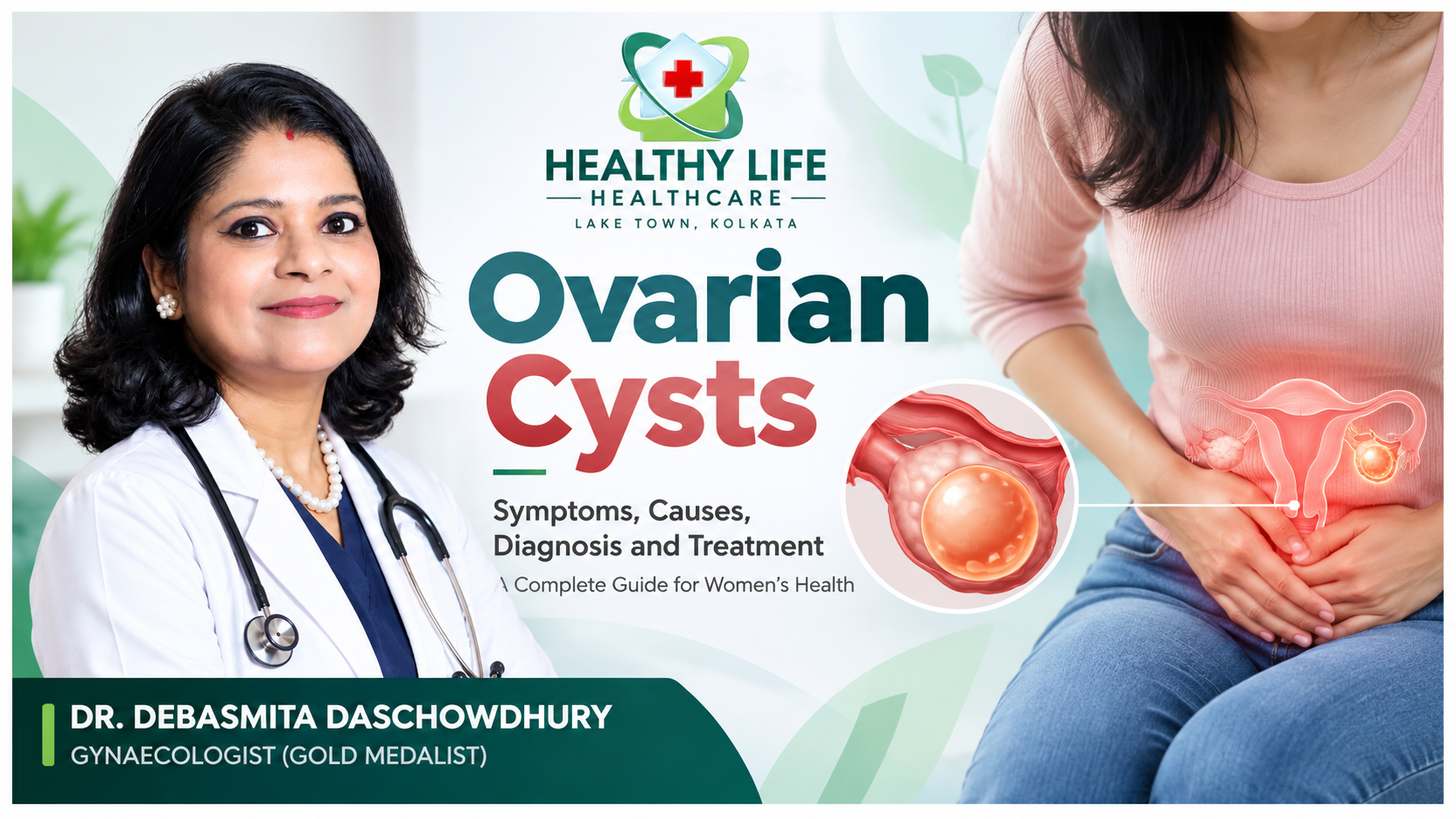
An ovarian cyst can sound frightening when a woman first hears the words “cyst in the ovary.” Many women immediately worry about cancer, infertility, surgery or future pregnancy. But the reality is more reassuring: most ovarian cysts are benign and many disappear naturally without treatment.
At the same time, an ovarian cyst should not simply be ignored. The type, size, appearance and symptoms associated with the cyst are important. Proper evaluation by a qualified gynaecologist in Kolkata can help a woman understand what is happening and whether observation, medication, follow-up or surgery is appropriate.
What is an ovarian cyst?
An ovarian cyst is a fluid-filled sac or pouch that develops in or on an ovary. Ovaries are part of the female reproductive system and play an important role in producing eggs and hormones.
Ovarian cysts are particularly common during the reproductive years. Some develop as a normal part of the menstrual cycle and are known as functional ovarian cysts. These commonly resolve on their own within several weeks.
Other types include endometriomas, cystadenomas and teratomas. Because different cysts behave differently, a woman should not assume that every ovarian cyst requires the same treatment.
What are the symptoms of ovarian cysts?
Many ovarian cysts cause no symptoms at all and may be discovered accidentally during a routine pelvic examination or ultrasound.
When symptoms occur, they may include:
- Lower abdominal or pelvic pain
- Pain on one side of the abdomen
- A feeling of heaviness or pressure in the lower abdomen
- Pain during sexual intercourse
- Changes associated with menstruation
- Abdominal fullness or bloating
- Frequent urination or bowel pressure when a cyst becomes large
Sudden, severe pelvic or abdominal pain can sometimes occur if a cyst ruptures or causes the ovary to twist, a condition known as ovarian torsion. Such symptoms require prompt medical attention.
Why do ovarian cysts develop?
There are several possible causes. Functional cysts can develop as part of the normal ovulation process. Other cysts may be associated with conditions such as endometriosis.
For some women, hormonal or reproductive health conditions may also influence the development of ovarian cysts. This is one reason why a detailed medical history and appropriate examination are important.
A woman should remember that having an ovarian cyst does not automatically mean that she has ovarian cancer. Most ovarian cysts are not cancerous. However, particularly after menopause, certain findings may require more careful evaluation.
How are ovarian cysts diagnosed?
When an ovarian cyst is suspected, a gynaecologist may recommend a pelvic examination and imaging.
Ultrasound is one of the most important investigations. It can help determine the cyst's size, location and appearance and whether it appears fluid-filled or contains solid components.
Depending on the woman's age, symptoms, medical history and ultrasound findings, the doctor may recommend additional investigations. In selected cases, blood tests such as CA-125 may be considered. However, CA-125 alone does not diagnose ovarian cancer, and results need to be interpreted in the context of other clinical findings.
Does every ovarian cyst require treatment?
No.
One of the most important messages for women is that not every ovarian cyst needs immediate surgery.
If a cyst appears benign, is relatively small and is not causing significant symptoms, the doctor may recommend watchful waiting. This means monitoring the cyst with follow-up examinations or ultrasound to see whether it changes or disappears. Many functional cysts resolve naturally after one or two menstrual cycles.
Treatment decisions depend on several factors, including:
- Type of ovarian cyst
- Size of the cyst
- Ultrasound appearance
- Symptoms
- Age
- Menstrual status
- Pregnancy plans
- Whether the cyst persists or grows
- Whether there are concerning clinical findings
When might surgery be considered?
Surgery may be recommended when a cyst is very large, persistent, causes significant symptoms or has features that raise concern for malignancy.
When surgery is required, the approach depends on the individual situation. A cystectomy removes the cyst while preserving the ovary when appropriate. In some circumstances, removal of an ovary, known as an oophorectomy, may be necessary. Minimally invasive laparoscopic surgery may be appropriate for selected benign-appearing cysts.
For women who wish to become pregnant in the future, fertility considerations are especially important when discussing treatment.
Ovarian cysts and fertility
Finding an ovarian cyst does not automatically mean that a woman will have difficulty becoming pregnant.
Some functional cysts have little or no impact on fertility. However, certain conditions, particularly endometriosis and endometriomas, can be associated with fertility problems.
Therefore, women who are trying to conceive and have been diagnosed with an ovarian cyst should discuss their individual situation with a gynaecologist rather than assuming the worst.
When should you see a gynaecologist?
Persistent pelvic pain, unusual menstrual changes, abdominal swelling, pain during intercourse or a known ovarian cyst deserves appropriate medical evaluation.
Women should seek urgent medical care if they experience sudden severe abdominal or pelvic pain, particularly when accompanied by symptoms such as vomiting, faintness or significant weakness. A ruptured cyst or ovarian torsion can require urgent assessment.
A woman's health deserves attention, not fear
Ovarian cysts are common, and the discovery of a cyst does not mean that something serious is necessarily wrong. What matters is understanding what type of cyst it is, how it looks, whether it is causing symptoms and how it changes over time.
Instead of worrying after reading information online, speak with a qualified gynaecologist in Kolkata who can assess your symptoms and recommend appropriate investigations.
At Healthy Life Healthcare, Lake Town, Kolkata, women can seek professional guidance for gynaecological concerns and discuss symptoms such as pelvic pain, menstrual irregularities and ovarian cysts with an experienced specialist.
Dr. Debasmita Daschowdhury, Gynaecologist (Gold Medalist), provides women-focused gynaecological care with an emphasis on proper evaluation, clear communication and individualized treatment.
Back to Blogs