Author: Dr. Subhashis Manna
Qualifications: MBBS, MS (Orthopaedics)
Consultant Orthopaedic Surgeon, SSKM (PG) Hospital, Kolkata
Healthcare Centre: Healthy Life Healthcare, Lake Town, Kolkata
Introduction: A Healthy Spine Supports a Healthy Life
Our spine plays an important role in almost everything we do, from standing and walking to sitting comfortably at work and enjoying time with our families. However, not everyone has a perfectly straight spine. One condition that can affect people of different ages is scoliosis, a sideways curvature of the spine that may also involve rotation of the vertebrae.
In India, where children spend long hours studying, adults often work at desks, and many people delay medical consultations because of busy schedules, awareness of spinal health is important. Parents may notice that their child's shoulders are uneven, while adults may experience changes in posture or persistent back discomfort.
The good news is that scoliosis can often be managed effectively when it is identified early and assessed by an orthopaedic specialist. Understanding the condition is the first step towards protecting spinal health and maintaining a good quality of life.
What Is Scoliosis?
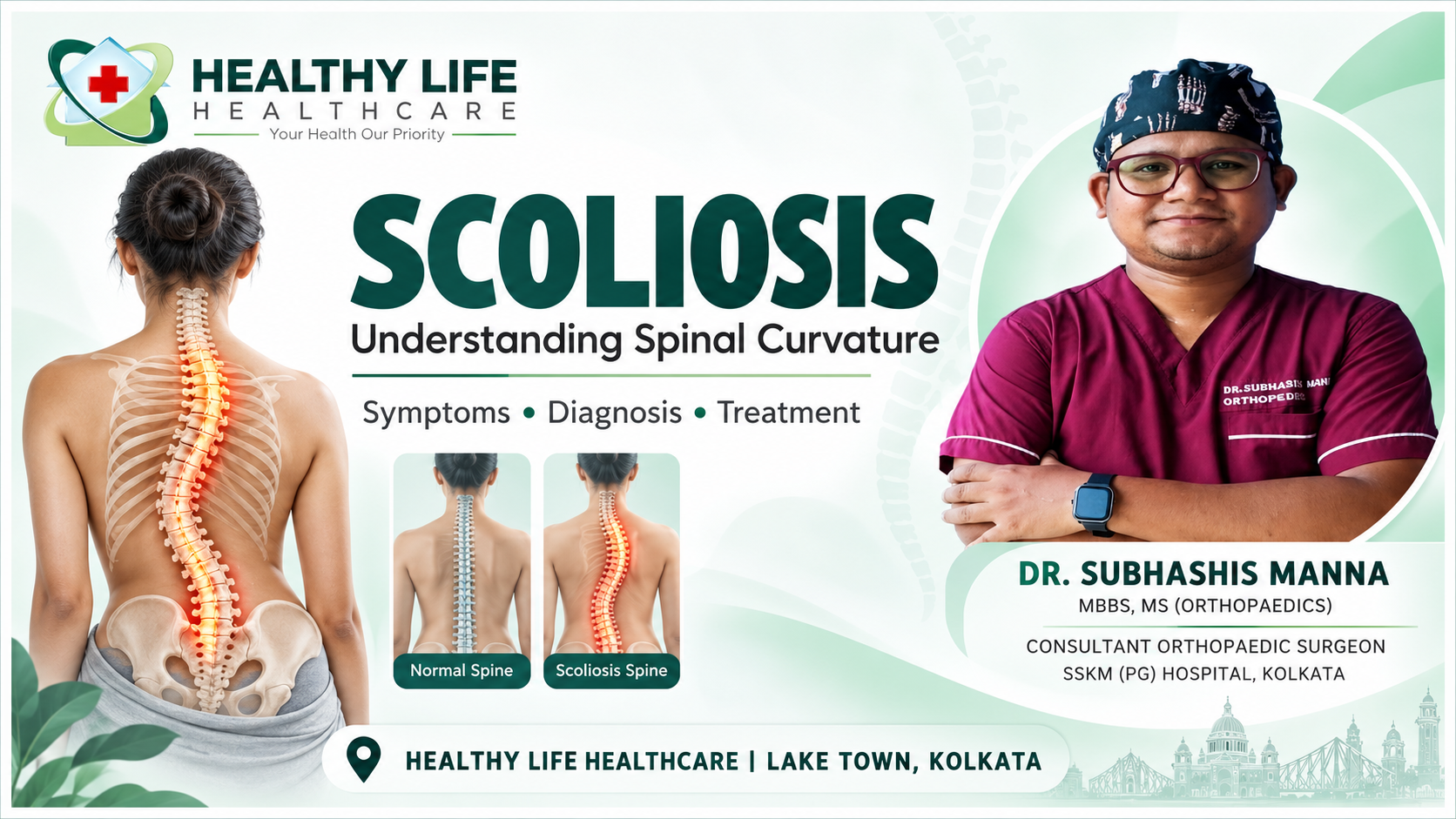
Scoliosis is a condition in which the spine curves sideways instead of appearing relatively straight when viewed from behind. The curve may resemble the letter C or S. In some cases, the vertebrae also rotate, causing visible changes in the shape of the back.
Scoliosis can develop during childhood or adolescence, although adults can also have scoliosis due to age-related spinal changes or a curve that began earlier in life.
The Spine Research Foundation in India notes that idiopathic scoliosis affects approximately 2% to 3% of the population, although this should not be interpreted as a confirmed national prevalence figure for India. The condition can affect boys and girls, and progressive curves are more common among adolescent girls. Source: Spine Research Foundation.
It is important to remember that every spinal curve is different. The degree of curvature, the patient's age, remaining growth and associated symptoms all influence the appropriate treatment.
What Causes Scoliosis in Children and Adults?
One of the most common forms is idiopathic scoliosis, which means the exact cause is unknown. It frequently develops during adolescence, when children experience rapid growth.
Other types include congenital scoliosis, which results from spinal bones developing abnormally before birth, and neuromuscular scoliosis, which is associated with certain neurological or muscular conditions.
Adults may develop degenerative scoliosis when age-related changes affect the spinal discs and joints.
A common misconception is that scoliosis is caused simply by sitting incorrectly, carrying a schoolbag on one shoulder or using a mobile phone for long periods. These habits can contribute to discomfort or poor posture, but they are not established causes of structural scoliosis.
Understanding the actual cause requires a proper medical assessment rather than relying on assumptions or home remedies.
Common Signs and Symptoms of Scoliosis
Scoliosis does not always cause pain, particularly in children. Sometimes, the first sign is a change in the appearance of the back.
Parents and adults should look out for:
-
One shoulder appearing higher than the other.
-
Uneven waistlines or hips.
-
One shoulder blade appearing more prominent.
-
Clothes hanging unevenly on the body.
-
The body leaning noticeably to one side.
-
One side of the back appearing higher when bending forward.
-
Back discomfort, muscle fatigue or stiffness, particularly in some adults.
These signs do not automatically confirm scoliosis. Differences in leg length, pelvic alignment and other conditions can create similar appearances.
If a child develops visible spinal asymmetry, or an adult notices a progressive change in posture, consulting an orthopaedic doctor in Kolkata can help establish the cause.
Why Early Detection Matters in India
In many Indian families, changes in a child's posture may initially be dismissed as a temporary problem. Parents may wait for the child to grow older before seeking medical advice.
However, some scoliosis curves can progress during periods of rapid growth. Early assessment helps determine whether the curve needs observation, bracing or specialist intervention.
Schools, parents and healthcare professionals can all contribute to awareness by recognising possible signs of spinal curvature. A simple observation of shoulder and hip symmetry may raise concern, but it cannot replace a clinical examination.
Early diagnosis does not mean that every patient needs treatment. Mild curves may only require periodic monitoring. The objective is to identify those patients who need intervention before a progressive curve becomes more difficult to manage.
How Is Scoliosis Diagnosed?
Diagnosis usually begins with a detailed medical history and physical examination by an orthopaedic specialist.
The doctor may assess posture, shoulder and hip alignment, spinal movement, balance and neurological function. A forward-bending examination may help identify asymmetry in the back.
When clinically indicated, standing spinal X-rays are used to evaluate the curve and measure its severity. The Cobb angle is a commonly used measurement for assessing scoliosis. MRI may be recommended in selected cases, particularly when symptoms or examination findings suggest an underlying neurological or other spinal problem.
Not every patient needs every investigation. The appropriate diagnostic approach depends on the patient's age, symptoms, examination findings and medical history.
What Are the Treatment Options for Scoliosis?
Scoliosis treatment should be individualised. The goal is to manage the curve, preserve function, reduce symptoms where possible and support the patient's overall well-being.
1. Observation and regular monitoring
Mild curves may require periodic clinical reviews and imaging when appropriate, especially while a child is growing. Monitoring helps the doctor identify changes that may require further intervention.
2. Physiotherapy and scoliosis-specific exercises
A physiotherapist may recommend exercises to improve strength, mobility, balance and body awareness. Scoliosis-specific exercise programmes may be useful for selected patients under professional guidance. Exercises should be tailored to the individual and should not be presented as a guaranteed way to straighten every spinal curve.
3. Bracing
A spinal brace may be recommended for selected growing children and adolescents who have curves at risk of progression. The decision depends on the degree of curvature, skeletal maturity and other clinical factors. Bracing aims primarily to reduce the risk of progression rather than guarantee complete correction.
4. Surgical treatment
Surgery may be considered for selected patients with severe or progressive curves, depending on the degree of deformity, symptoms, functional impact and individual circumstances. A specialist assessment is necessary to understand the potential benefits, risks and alternatives.
Patients should avoid unverified treatments or exercises advertised as permanent cures for scoliosis.
Living With Scoliosis: Emotional Support Matters
For a child or teenager, discovering that their spine is curved can create anxiety about appearance, sports, friendships and the future. Adults may worry about pain, mobility or their ability to continue working comfortably.
Families can make a meaningful difference by listening without judgement, avoiding unnecessary criticism of posture and encouraging appropriate medical care. Children should be supported in maintaining normal activities whenever medically appropriate.
Many people with scoliosis continue to study, work, exercise and lead active lives. The condition does not define a person's abilities or future. With appropriate assessment, realistic expectations and individualised care, patients can make informed decisions about their spinal health.
Consult an Orthopaedic Specialist in Lake Town, Kolkata
If you or your child have noticed uneven shoulders, an unusual spinal curve or persistent back discomfort, consider seeking a professional evaluation rather than waiting for symptoms to worsen.
Dr. Subhashis Manna, MBBS, MS (Orthopaedics), Consultant Orthopaedic Surgeon at SSKM (PG) Hospital, Kolkata, provides orthopaedic consultation at Healthy Life Healthcare in Lake Town, Kolkata.
A consultation can help determine whether the observed changes require further investigation, monitoring or treatment. The appropriate plan will depend on the individual's condition and clinical findings.
Healthy Life Healthcare
Address: P-912, P-354, Block A, near Hanuman Mandir, Lake Town, Kolkata, West Bengal 700089.
Phone: 085829 14753
If you are searching for an orthopaedic doctor in Lake Town, scoliosis consultation in Kolkata or guidance about spinal curvature in children and adults, seeking timely professional advice is a sensible step towards better spinal health.
Conclusion
Scoliosis is more than a change in the shape of the spine. It is a condition that deserves awareness, careful assessment and compassionate care. In India, improving public understanding can help families recognise possible warning signs and seek medical advice without unnecessary fear.
Early evaluation, appropriate monitoring and individualised treatment can make a meaningful difference for many patients. If you notice changes in your child's posture or your own spinal alignment, do not ignore them. A conversation with a qualified orthopaedic specialist can help you understand the condition and decide on the next steps with confidence.
Medical disclaimer: This article is intended for general educational purposes and does not replace a personal medical consultation, diagnosis or treatment plan.
Back to Blogs